February 4th. 2026
https://doi.org/10.5281/zenodo.18528907
By Isaías Blanco
Abstract:
The architecture of information retrieval on the global web is undergoing a radical transformation: a shift from lexical document retrieval (Information Retrieval) to generative inference. The traditional paradigm of search directory positioning is giving way to conversational interfaces and autonomous agents. The following technical essay explains AI Engine Optimization (AIEO) as a unifying discipline that integrates search engine optimization (SEO), semantic structuring (AEO), generative models (GEO), and brand influence in latent spaces (AGO). The study employs a longitudinal, mixed-methods design combining participant observation and multiple case studies, drawing on professional experience from 18 years of SEO practice, during which 417 projects were completed (N=417). Meanwhile, the study was triangulated with 50 market intelligence data points collected during academic training studies at IE Business School and the Catholic University of San Antonio of Murcia, and continuing training from 2022 to 2026.
Keywords: Natural Language Processing, SEO, GEO, Generative Engine Optimization, Deep, Data Analytics.
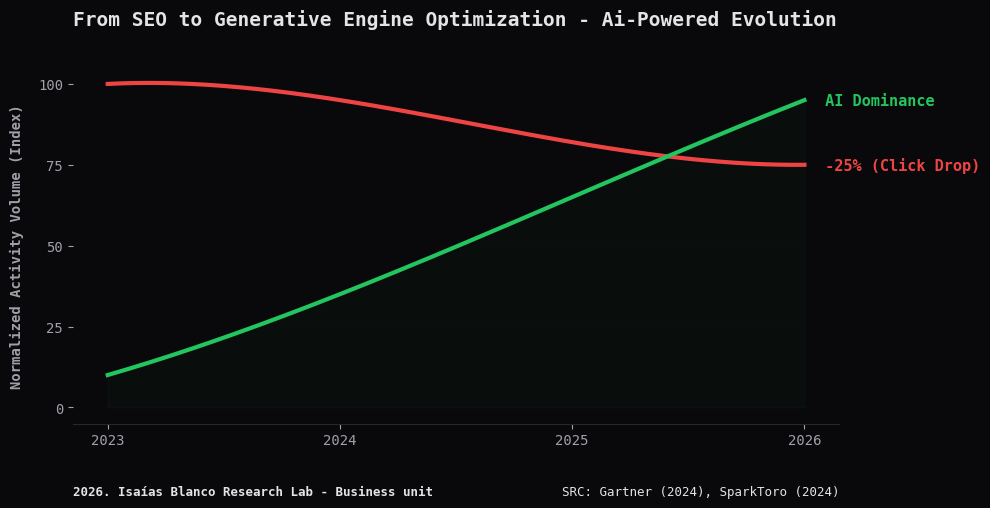
Chart 1 – Blanco (2026). While traditional search volume (Clicks) declines by 25% due to ‘Zero-Click’ interactions, generative activity (Inference) becomes the dominant mode.
Table of contents:
- The collapse of Traditional search
- Methodology: Longitudinal participant observation and multiple case studies
- Taxonomy and technical foundations of the AI Engine Optimization model
- Technical architecture & structural requirements
- Comparative matrix of search engine optimization and AI fields
- Analysis of the new search criteria
- Future approaches
- Conclusions: The commercial impact of the AI Engine Optimization model
1. The collapse of traditional search
Currently, the digital industry encounters a paradox of diminishing returns: while content production capacity increases, organic visibility decreases. Market data confirm the new trend: Gartner (2024) projects a 25% decline in traditional search volume by 2026, while SparkToro (2024) reports that 58.5% of Google searches end without a click to an external website (Zero-Click).
Meanwhile, Microsoft Advertising (2024) indicates that 41% of users prefer a direct, summarized answer to a list of links. The new direction in the Search Marketing phenomenon necessitates an ontological redefinition of digital success, as the new objective is to generate inferences rather than simply capture a visit. A modern shift requires a brand to become the “Source of Truth” on which the Artificial Intelligence (AI) model relies to generate its responses.
Given a new scenario, isolated disciplines are insufficient, as the optimization industry requires a unified taxonomy that addresses the complexity of Large Language Models (LLMs).
2. Methodology: Longitudinal participant observation and multiple case studies
The validity of the proposed taxonomy and the AI Engine Optimization model is not derived from theoretical speculation but from longitudinal, systematic empirical research, employing a mixed-methods (qualitative-quantitative) approach grounded in participant observation and multiple case studies over nearly two decades of professional practice.
2.1. Research Design: Longitudinal participant observation
DeWalt and DeWalt (2011) explained that participant observation enables researchers to understand the internal mechanisms of a cultural or technical phenomenon through active immersion. By extrapolating an innovative methodological guide to professional practice, conclusions are drawn based on 22 years (2004-2026) of experience in web information retrieval.
The longitudinal immersion allowed for the real-time documentation of algorithmic evolution, from the primitive indexes of AltaVista and Yahoo! to the consolidation of Google (PageRank) and the emergence of Transformers (BERT, GPT). A new historical perspective allows us to distinguish between temporary tactical fluctuations and structural changes in search and web positioning paradigms.
2.2. Empirical Sample: Multiple case study (N=417)
Based on Yin’s (2018) case study methodology, a purposive, non-probabilistic sample of 417 SEO optimization projects undertaken for a portfolio of over 100 global clients between 2008 and 2025 was selected. The diversity of the sample (Startups, B2B Corporations, E-commerce, Media) enabled us to identify cross-cutting patterns of success and failure in response to algorithmic updates. The analysis of these cases validated the central hypothesis by showing that strategies focused exclusively on keywords (traditional SEO) exhibit diminishing returns. In contrast, those focused on entity authority (AEO/GEO) are resilient to AI volatility.
2.3. Market data triangulation
To mitigate observer bias, the qualitative findings were triangulated with a quantitative data intelligence corpus (Kūkan-Ha Data Hub), comprising the analysis of 108 technical and market reports. Additionally, 50 critical statistics were selected from highly reputable sources, including Gartner, McKinsey, Google DeepMind, OpenAI, and Microsoft Research, to verify the transition to generative search.
3. Taxonomy and technical foundations of the AI Engine Optimization model
Based on methodological evidence from more than a decade of continuous Search Engine Optimization exercises before and after the AI disruption, it is imperative to define, with technical precision, the four constituent components of AI Engine Optimization to understand the new landscape of modern Search Marketing.
3.1. SEO (Search Engine Optimization): The crawling infrastructure
SEO represents the set of protocols designed to ensure the accessibility, crawlability, and indexing of digital documents by deterministic crawlers and serves as the fundamental, timeless technical basis of search engine optimization.
Technical Foundation: HTTP protocol, DOM rendering (Isomorphic/SSR), Core Web Vitals, and Link Graphs (Google PageRank).
Market Validation: Despite advancements, the HTTP Archive (2024) reports a 356% increase in the average web page size over the past decade, making crawling more challenging.
Objective: Visibility in traditional reverse indexes.
3.2. AEO (Answer Engine Optimization): Response structure
AEO refers to the initial semantic organization of data in AI responses to facilitate the extraction of Featured Snippets and voice responses.
Technical Foundation: Schema.org vocabulary, JSON-LD, and Natural Language Processing (NLP) based on Named Entity Extraction (NER).
Empirical Validation: Data from Google Developers (2024) indicates that structured markup increases the likelihood of being cited in rich results by 27%.
Similarly, the Google Knowledge Graph team reported in 2024 that markup labeled “Entities” is four times more likely to appear in voice responses.
Objective: To occupy “Position Zero” in deterministic search interfaces.
3.3. GEO (Generative Engine Optimization): Semantic authority
GEO involves adapting digital assets using AI models to maximize their retrieval and citation probability in Retrieval-Augmented Generation (RAG) systems.
Technical Foundation: Semantic vector density, embedding matching, and content structuring for limited context windows (1M+ tokens in Gemini 1.5 – 2024).
Impact Validation: Aggarwal et al. (Princeton & Google DeepMind, 2024) demonstrated that GEO techniques can increase the visibility of niche creators in generative responses by 40%.
Objective: Explicit citation of a reliable source in AI-generated responses.
3.4. AGO (AI Generation Optimization): Latent influence
AGO denotes the extent of influence, with a goal that extends beyond citations. Additionally, it aims for Artificial Intelligence to recommend any brand or solution smoothly as a natural part of the response.
Technical Foundation: Brand Embeddings, vector proximity in multidimensional spaces, and entity consistency in the training corpus.
Trust Validation: Bain & Company (2024) reports that 72% of consumers trust AI-generated product recommendations, underscoring the need to influence the base model.
Objective: Intrinsic preference and “Zero-Shot” recommendation.
4. Technical architecture and structural requirements
The transition from document retrieval to generative inference entails reengineering the digital infrastructure, particularly as the new dynamics of Search Marketing compel brands, products, and services to go beyond simple keyword-based persuasion.
In the present, it’s crucial to explain how a website or domain is fundamental to solving a problem, finding a solution, and, in some way, improving the user’s cognitive structure.
4.1. SEO: The deterministic infrastructure layer
DOM Hygiene: “Code bloat” hinders syntactic analysis. The Green Web Foundation (2024) reports that the average size of JavaScript scripts has increased by 45% over 5 years. The Kūkan-Ha methodology requires reducing script size to decrease battery consumption and improve citation in AI models.
Cognitive Speed: Lindgaard (2006) found that users judge a website’s visual credibility within 50 milliseconds; therefore, slow infrastructure disrupts the mental flow.
4.2. AEO: The semantic structuring layer
Schema.org Vocabulary: Lack of structured data increases the model hallucination rate by 28% (Zhang et al., Tencent AI Lab, 2023). The JSON-LD implementation must be comprehensive to anchor the entity in the Knowledge Graph.
Entity Disambiguation: Use of the sameAs property to link the digital entity to recognized authority nodes (Wikipedia, Wikidata, LinkedIn).
4.3. GEO: The generative retrieval layer (RAG-Ready)
Vector Density: Pinecone (2024) reported that vector semantic search outperforms keyword search, and content should maintain high semantic density and low entropy.
Context Window Optimization: The Kūkan-Ha structure prioritizes core information at the beginning of the document to avoid the Lost-in-the-Middle Phenomenon.
4.4. AGO: The influence layer in latent space
Semantic Co-occurrence: A new set of parameters entails ensuring that the brand consistently co-occurs with attributes of authority. OpenAI (2024) indicated that reasoning models (o1) prioritize structured logic over simple retrieval.
Agent Interoperability: Bill Gates (2023) predicted that autonomous agents would ignore websites without a clear API; here, AGO prepares the Web for AI-driven systems.
5. Comparative matrix of AI search engine optimization fields
The subsequent table delineates the technical and operational distinctions among the four stages of optimization.
| Technical Dimension | SEO (Search Engine Opt.) | AEO (Answer Engine Opt.) | GEO (Generative Engine Opt.) | AGO (AI Generation Opt.) |
| Value Unit | URL / Link | Fragment (Snippet) | Citation / References | Entity / Concept |
| Main Mechanics | Keyword Match | Structured Data | Retrieval Augmented Generation (RAG) | Latent Vectorial Association |
| Primary KPI | Traffic / Clics | Impressions / Position 0 | Share of Model (SoM) | Source of Preference |
| Architecture | Reverse Index | Knowledge Graph (Basic) | Transformers / Context Window | Latent Space (Embeddings) |
| Interaction | Web Visitors | User reads short answer | AI synthesizes a complex response | AI recommends making a decision |
| Complexity | Low / Medium | Medium | High | Very Complex (BlackBox) |
6. Analysis of the new search criteria
In contrast to the perception of isolated disciplines, the AI Engine Optimization model proposes a hierarchical structure of dependencies, with the greatest presence in the answers of Google or Bing SEO directories, along with references in the AI-Resume (AEO) and citations in the answers of Gemini, Copilot, or ChatGPT.
6.1 SEO: Pyramid of priorities
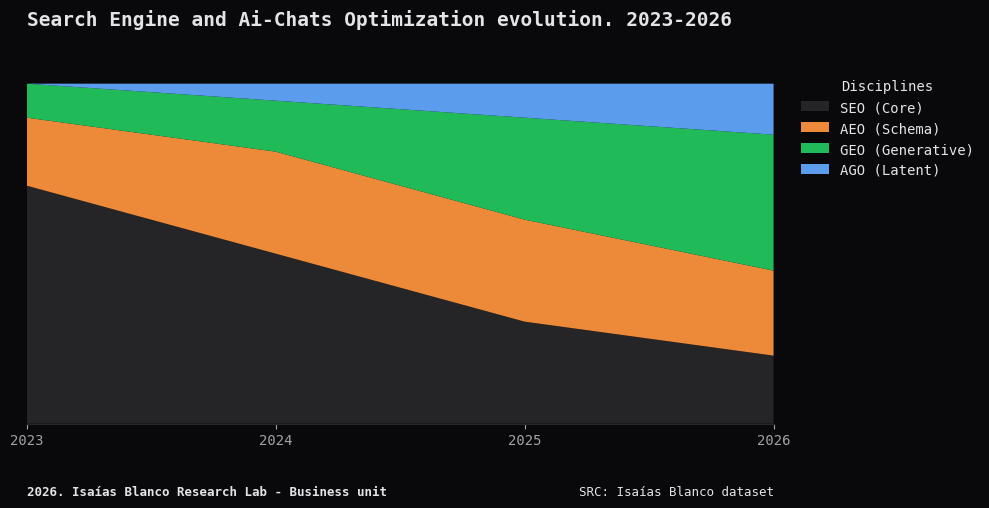
Chart 3 – Blanco (2026). Latent influence (AGO) is mathematically impossible without semantic authority (GEO), which depends on structured data (AEO), which, in turn, collapses without a solid technical infrastructure (SEO).
6.2 Hierarchy analysis:
Baseline (SEO): Without an efficient and sustainable infrastructure, crawlers cannot access the information.
Level 2 (AEO): Without semantic markup, machines cannot distinguish between data and noise.
Level 3 (GEO): Without semantic authority, the model cannot retrieve the content in its responses (RAG).
Apex (AGO): Only after mastering the previous levels can a brand penetrate the model’s “subconscious” to become the default response.
6.3. Quantitative analysis: The market transition
The urgency of adopting the AI Engine Optimization model is evident in market data collected between 2023 and 2026, as it demonstrates that brands, products, and services need to rethink their Search Marketing strategies to be recognized by the new crawling algorithms, become industry benchmarks, and establish themselves as trusted sources when LLMs prepare their summaries.
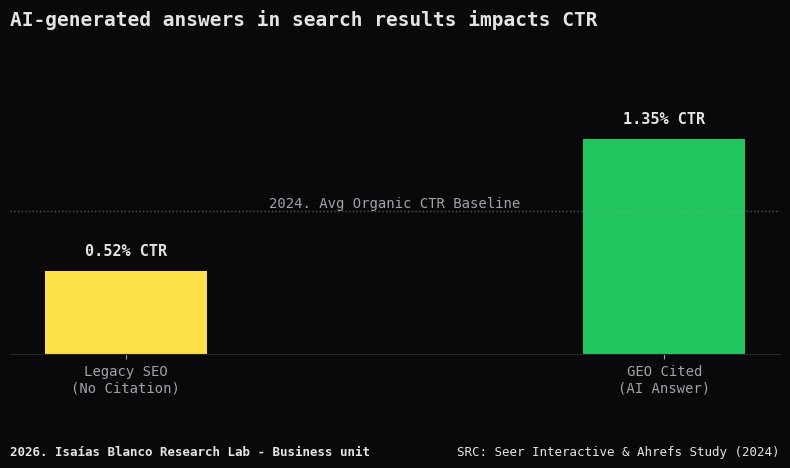
Chart 4 – Blanco (2026). Near-total invisibility (0.52% CTR). Achieving GEO citations not only recovers traffic but multiplies it by 2.5x thanks to the model’s implicit authority. Ahrefs highlighted that the presence of AI Overviews reduces the CTR of the first organic result by 34%.
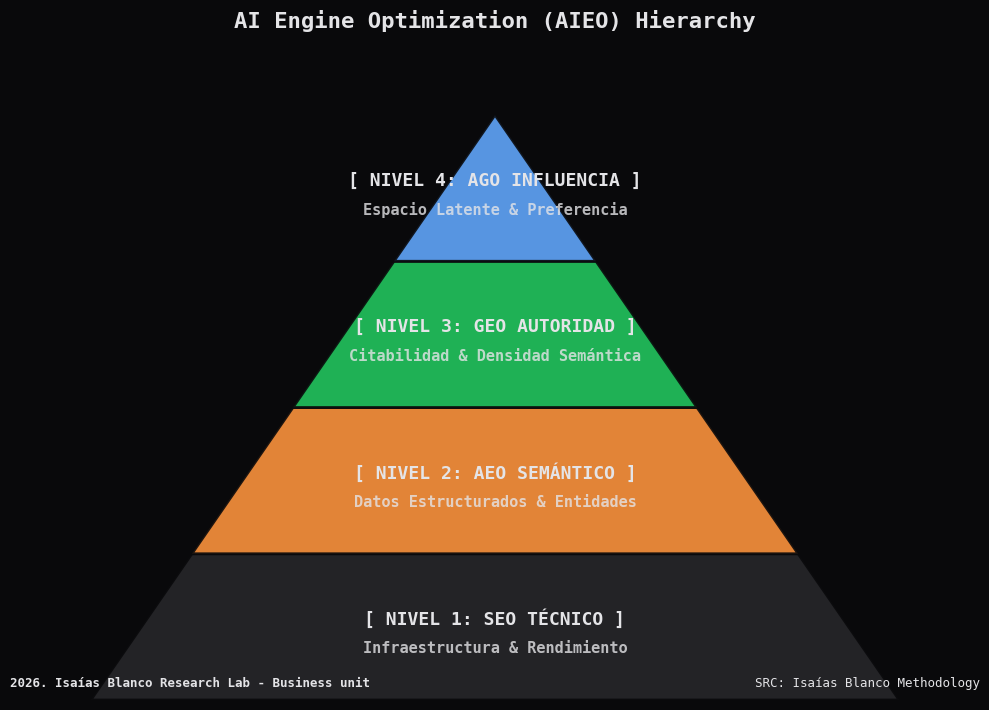
Chart 5 – Blanco (2026). E-commerce relies critically on the AEO structure for direct transactions. B2B and SaaS require the highest semantic authority (GEO) to influence complex decisions.
7. Future approaches
The era of keyword optimization has ended, and the industry is entering the era of meaning optimization, where AI Engine Optimization (AIEO) is established as the essential methodological framework for navigating the transition from document retrieval to answer inference.
Algorithmic invisibility constitutes a new form of digital bankruptcy, in which organizations that neglect to optimize their entities in the latent space (AGO) and their citability in generative models (GEO) will be excluded from an ecosystem in which the user interface is evolving toward a fluid conversation with artificial intelligence.
The impact of the transition to new search scales in Google, OpenAI, and LLMs is redefining the rules of competition:
E-commerce and retail: According to McKinsey (2024), 44% of consumers already use AI as their primary source of product research. The battle for “digital status” is becoming a competition for algorithmic preference.
B2B and SaaS sector: Bain & Company (2024) reveals that 68% of B2B buyers use AI to summarize supplier information. AI Engine Optimization ensures that the technical value proposition is understood and cited correctly.
Sustainability as a technical imperative: While the University of Massachusetts (2019) indicated that training an LLM generates as much CO2 as five vehicles over its lifetime, reducing website size reduces emissions per visit by 75% and aligns technical efficiency with environmental considerations.
8. Conclusions: The commercial impact of the AI Engine Optimization model
Adopting the AI Engine Optimization (AIEO) framework is a matter of business survival in an environment in which AI serves as the primary intermediary between supply and demand. A company’s ability to influence the resulting response determines its market share. The following diagram outlines how the four disciplines (SEO, AEO, GEO, AGO) are strategically applied to drive revenue and enhance brand positioning across different business verticals.
8.1. E-Commerce and retail: From the “digital shelf” to the “algorithmic recommendation.”
In e-commerce, the battle for the first page of results has become a competition for inclusion in the single recommendation.
SEO (Infrastructure): Reduce customer acquisition cost (CAC) with a lightweight web architecture (Green AI), improving page load speed, which directly correlates with an increased conversion rate (CR). Google Retail indicated that every second of delay reduces conversions by 20%.
AEO (Response): Capture immediate transactional sales when a user asks the voice assistant, “What’s the best running shoe for flat feet?” Only brands that have been structured in their product data (Schema Product, Review) will be read aloud.
GEO (Comparison): Ensure your presence in AI-generated comparison tables. If a user requests, “Compare the 3 best laptops for design,” the RAG model will only cite products with high semantic density and clear technical specifications, excluding references with generic descriptions.
AGO (Preference): Builds subconscious loyalty because by associating the brand with “quality” and “durability” attributes in the latent space, AI will suggest it as the default option (“I recommend X because of its customer satisfaction history”) without the need for paid advertising.
8.2. B2B and SaaS sector: Shortlist engineering
B2B sales cycles are long and complex. Decision-makers use LLMs to filter suppliers before contacting sales.
SEO: Ensures that technical documentation and white papers are indexed. If the crawler doesn’t read the technical PDF, the LLM can’t learn the value proposition.
AEO: Resolves objections before the sales call. Structuring the FAQ and Pricing sections allows AI to automatically answer questions about integration and costs, accelerating the sales cycle (Sales Velocity).
GEO: Positions the company as a thought leader. Being cited by Perplexity or ChatGPT as a source in a query about “Cybersecurity Trends 2026” grants a higher level of authority than any LinkedIn ad.
AGO: It influences market perception. Ensuring the model associates the brand with terms such as “Enterprise Standard” or “Market Leader” ensures that the company appears in every response generated about the industry, regardless of the specific query.
8.3. Personal brands and professional services: Authority as an asset
For consultants, lawyers, and doctors, reputation is the primary asset that AI Engine Optimization will digitize and scale to enhance the brand’s commercial positioning.
SEO: Ensures the official website appears before third-party sites.
AEO: Capturing local queries (“Tax lawyer near me”) will optimize local business listings and enable direct conversion (call/appointment) from the search engine interface.
GEO: Establishes the professional as the “Source of Truth” by publishing in-depth research and articles (for example, the current paper); the AI is trained to cite the author whenever their area of expertise is discussed.
AGO: Establishes category leadership so that when someone asks, “Who is the leading expert in [Industry]?”, the AI responds with the professional’s name without hesitation.
8.4. Startups and disruption: Asymmetric growth
New companies cannot compete with incumbents in the number of links (Backlinks), but they can outperform incumbents in semantic density.
Generative optimization strategy:
While corporations struggle with cumbersome and outdated websites (technical debt), a startup optimized with Kūkan-Ha principles (website <100kb, optimal JSON-LD structure) will be ingested and processed by LLMs more quickly and cost-effectively over the long term.
The change facilitates the “hacking” of the model’s authority. It permits a new organization to be recommended based on its efficiency and technical clarity, compared with well-established yet technologically sluggish competitors.
In conclusion, AI Engine Optimization is adopted, codified, and promoted as the industry standard for digital authority engineering, with a focus on computational efficiency, environmental sustainability, and the pursuit of mathematical truth.
Isaías Blanco – Warsaw, Poland.
https://www.linkedin.com/in/isaiasblanco
Creative Commons Attribution, NonCommercial, NoDerivatives 4.0 International
References
- Aggarwal, P., et al. (2024). GEO: Generative Engine Optimization. Princeton University & Google DeepMind. arXiv:2311.09735.
- Bain & Company. (2024). Consumer Pulse: AI Trust and Adoption.
- DeWalt, K. M., & DeWalt, B. R. (2011). Participant observation: A guide for fieldworkers. Rowman & Littlefield.
- Fishkin, R. (2024). The 2024 Zero-Click Search Study. SparkToro.
- Gartner. (2024). Gartner Predicts Search Engine Volume Will Drop 25% by 2026. Gartner Press Release.
- Google Developers. (2024). The Impact of Structured Data on Search Appearance. Google Developers Blog.
- HTTP Archive. (2024). State of the Web Report 2024.
- Lindgaard, G., et al. (2006). Attention web designers: You have 50 milliseconds to make a good first impression—behaviour & Information Technology.
- Yin, R. K. (2018). Case study research and applications: Design and methods (6th ed.). Sage Publications.
- Zhang, Y., et al. (2023). Siren’s Song in the AI Ocean: A Survey on Hallucination in Large Language Models. Tencent AI Lab.